A & C Driving School
Roundabouts
Roundabouts
The rules relating to Roundabouts
Always follow the correct procedure at Roundabouts
You should treat roundabouts as you would normal junctions, which means, you yield right of way to traffic already on the roundabout.
As you approach a roundabout you should take note and act on all of the information available to you, including traffic signs, traffic lights and lane markings, which direct you into the correct lane.
You should,
- Decide as early as possible which exit you need to take.
- Use Mirror - Signal - Mirror - Maneuver at all stages.
- Signal your intentions in good time so as to give other road users appropriate warnings.
- Get into the correct lane.
- Adjust your speed and position to fit in with traffic conditions.
- Be aware of the speed and position of all the traffic around you.
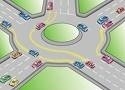
When you reach the roundabout you should,
- Give priority to traffic approaching from your right, unless directed otherwise by signs, road markings or traffic lights.
- Pay attention to vehicles already on the roundabout, be aware of their signals and try to judge their intentions.
- Look forward before moving off to make sure the traffic in front of you has moved off first.
- Be aware of the presence of cyclists, Scooters or motorcyclist alongside you before moving off.
Generally speaking when approaching a “two lane” roundabout, treat it like a clock face.
- If the exit you wish to take is the 1st exit, or is before or at the 12 o'clock point then stay in the left lane.
- If the exit you wish to take is after the 12 o'clock point then treat it as a right hand turn and stay in the right hand lane.
When approaching the roundabout....
- Check your Mirrors - Ask yourself if it is safe to perform this Manoeuvre.
- Signal - To show your intention - Remember that signals are merely indications of intent, They do not confer right of way.
- Manoeuvre - When it is safe perform your Manoeuvre.
Manoeuvre is broken down into three sections
- Position - Ensure you are in the correct road position for the manoeuvre you are about to perform .
- Speed - Adjust you speed accordingly on approach to the roundabout.
- Look - Look onto the roundabout you are about to enter to ensure that it is safe before you commit yourself.
Taking the first exit - Making a Left Turn
- On approach to the roundabout Adjust your speed accordingly by Slowing Down, Signal left and get into the left hand lane, Checking your Left Blindspot before moving over.
- Approach the roundabout checking to your right to ensure it is safe for you to proceed.
- If it is not safe then you must STOP.
When it is safe then you can commit yourself to the left hand turn checking the road you are about to enter is clear.
After completing your turn check your
Left Mirror - To ensure there is no one on your left hand side (Scooters, Cyclists, Motorbikes)
Main Mirror - As you are now on a new road you need to re access what is going on behind you.
Right Mirror - To see if anybody is trying to overtake you.
If in doubt, play safe and YIELD
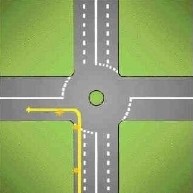
Taking the second exit - Driving Straight ahead
(The Yellow line on the Image)
On approach to the roundabout Signal left and get into the left hand lane.
Knock off your Signal.
Approach the roundabout checking to your right to ensure it is safe for you to proceed.
If it is not safe then you Must STOP.
When it is safe then you can commit yourself to the roundabout keeping in the left hand lane.
Continue on past the first exit and as you pass it then put on your Left hand signal indicating you intend taking the next exit off the roundabout.
Check your Left mirror to ensure there is no one on your Left hand side that might cause you a problem as you are exiting the roundabout.
After completing your turn then check your
Left Mirror - To ensure there are no one on your left hand side.
Main Mirror - As you are now on a new road you need to re access what is going on behind you.
Right Mirror - To see if anybody is trying to pass you out.
Normally if the road you are on, is an unmarked road then your position will be as close as safely practical to the left hand side of the road.
If the road you are on is marked with lanes, then your position will be the left-most lane.
If the lanes are marked with directional arrows then select the most appropriate marked lane.
But if a choice of marked lanes is offered, use the most appropriate marked left lane.
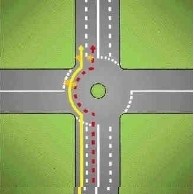
Exceptions to the General Rule of Roundabouts
(The Red line on the image)
There is one exception to the general rule of roundabouts and this comes into play only when you are going straight ahead at the 12 o clock exit.
You can use the right hand lane on a roundabout when going straight ahead if the road markings allow...
i.e. If there are two lanes approaching a roundabout and there are straight ahead arrows painted on the right hand lane.
or
If there are two lanes approaching a roundabout and there is a Left turn only arrow painted on the left hand lane or if there is a Bus Lane painted on the left hand lane.
Taking the third or more exit - Making a Right Turn
On approach to the roundabout Signal right and get into the right hand lane in good time.
Approach the roundabout checking to your right to ensure it is safe for you to proceed.
If it is not safe then you Must STOP.
When it is safe then you can commit yourself to the roundabout keeping in the right hand lane and continue to indicate right.
Continue on past the first and the second exits.
As you pass the exit before the one you intend to leave by then put on your Left hand signal indicating you are taking the next exit off the roundabout.
Check your Left mirror to ensure there is no one on your left hand side that might cause you a problem as you are exiting the roundabout.
After completing your turn then check your
Left Mirror - To ensure there are no one on your left hand side.
Main Mirror - As you are now on a new road you need to re access what is going on behind you.
Right Mirror - To see if anybody is trying to overtake you.
In some instances, a roundabout exit with two or more lanes may narrow into one lane over a short distance.
You should make yourself aware of the road markings and get into the appropriate lane when safe to do so, remembering to yield to traffic coming from the right.
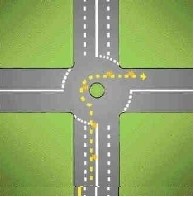
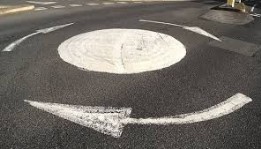
MINI ROUNDABOUTS
Approach in the same way as normal Roundabouts.
All vehicles must pass around the central markings except for larger vehicles that are physically incapable of doing so.
Remember that there is less space to manoeuver and less time to signal.
In all cases watch out for and give plenty of room to the following...
Pedestrians who may be crossing the approach and exit roads.
Traffic crossing in front of you on the roundabout, especially vehicles intending to leave by the next exit.
Traffic which may be straddling lanes or positioned incorrectly.
Motorcyclists.
Cyclists who may stay in the left-hand lane and signal right if they intend to continue round the roundabout.
Long vehicles (including those towing trailers) which might have to take a different course approaching, or on the roundabout because of their length. Watch out for their signals.
For a printable version of the Rules relating toclick on the PDF file attached.